
A life sciences digital transformation, from discovery to launch
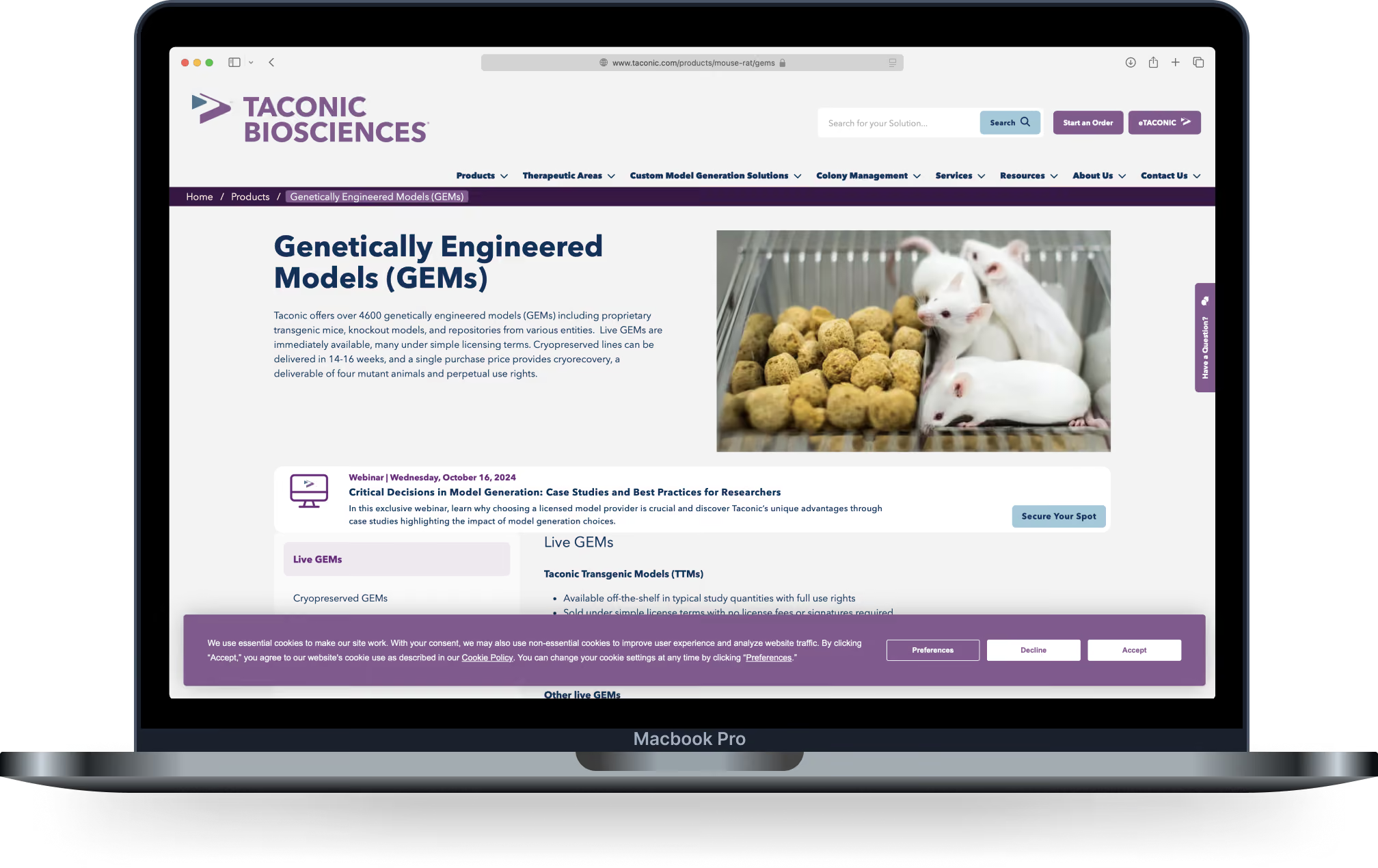
One of the world's leading providers of research animal models came to us to turn an aging website into an engine for growth. We assessed the business, set the strategy, redesigned the experience, and rebuilt the site on a modern platform, then migrated thousands of pages and launched it.
Key Performance Indicators
At a glance
- Client: Taconic Biosciences
- Sector: Life sciences, research models, drug discovery and development
- Engagement: current-state assessment, digital strategy and roadmap, technology evaluation, UX and UI design, information architecture, content strategy, platform rebuild, content migration, launch, and training
- Platform: Adobe Experience Manager (AEM)
- Standards met: WCAG 2.1 AA
Who Taconic is
Taconic Biosciences is a life sciences company that provides the research models the drug discovery and development industry depends on. From its base in Rensselaer, New York, it offers more than 4,600 genetically engineered models, including proprietary transgenic mice, knockout models, and repository lines, maintained to the Murine Pathogen Free health standard and supported by services from colony management to CRISPR model generation. Its customers are scientists, and its website is where many of them first evaluate whether Taconic can supply the exact model their program needs.
That makes the website a commercial instrument, not a brochure. When it works, it shortens the path from a scientist's question to a Taconic model. When it does not, it costs the business.
The challenge
Taconic set an ambitious goal and asked us to help make it reachable. The organization wanted a comprehensive digital transformation that could support a doubling of digitally driven revenue, deliver a frictionless customer experience, and put a real digital marketing strategy behind a business that intended to strengthen its position as a leader in its market.
The site standing in the way had real gaps. Its content management system, Movable Type, was outdated, could not be upgraded, and was no longer capable of supporting the customer experience the business needed to drive revenue. The customer experience itself was disjointed and created frustration, and the data showed it, with high bounce rates and low conversion. The ecommerce experience did not match what customers expected. And marketing, sales, and service worked in silos rather than as one motion.
The legacy site carried the weight of years. Across the measurement window we reviewed, it had served millions of pageviews but bounced nearly seven in ten visits, and some of the most important pages, including product and inquiry pages, bounced far higher than that. The demand was there. The platform could not convert it.
Discovery and assessment
We did not start with a redesign. We started with a diagnosis.
In the second half of 2022, beginning from a kickoff in August, we ran a full current-state assessment of Taconic's digital business and mapped the future-state architecture it would need. We evaluated the platforms at the center of the business, content management, ecommerce, analytics, and digital asset management, scoring each against the categories that decide whether a platform can carry a business of Taconic's scale: functionality out of the box, architecture, and risk. We benchmarked the options against independent industry analysis rather than vendor claims, which pointed clearly toward an enterprise content platform for the CMS and surfaced the realistic contenders for commerce.
Alongside the technology work we assessed the go-to-market engine. We ran a health check of the CRM, a marketing-automation recommendation, an SEO and keyword strategy, and an analytics review, and we interviewed the people who actually run Taconic's digital operation across marketing, inside sales, IT, customer experience, and ecommerce. The assessment converged on four outcomes the transformation had to deliver: unlock new revenue, improve operational efficiency, drive customer engagement, and transform the customer experience.
From that we built the thing a board can act on: a prioritized roadmap of initiatives, each tied to the gap it closed and the effort it required, from design research and content strategy through the CMS re-platforming itself, content migration, a digital asset management system, marketing automation, analytics, and governance. The strategy gave Taconic a sequence and a business case, not just a wish list.
Define and design
With the direction set, we moved into a define-and-design phase that turned strategy into something buildable.
We mapped the information architecture from the customer in, delivering a complete site map, an architecture for the new CMS, and a set of scope matrices that defined exactly what the platform had to do. We built eight customer personas and the user journeys that connect them to Taconic's models and services, and we ran content mapping workshops with Taconic's own teams to agree on what each page is for before we designed it. We produced homepage concepts and a mood board, then the primary templates, then a design system and style guide that would keep the rebuilt site consistent as it grew. Every design deliverable was held to WCAG 2.1 AA.


Build and technology
We rebuilt Taconic's website on Adobe Experience Manager, the enterprise platform the technology evaluation had pointed to.
The build stood up AEM with Adobe Cloud Manager managing deployment, and used a component framework so the site could be assembled and maintained from a shared library rather than hand-built page by page. We integrated the Adobe marketing and analytics tools the strategy called for, including Adobe Analytics, Target, Launch tag management, and Dynamic Media, along with the digital asset management that a catalog of this size demands, a video player, consent management, and HubSpot forms. We designed the full set of templates the business runs on, from the homepage and category landing pages to the model product pages, content and insights detail pages, search and search results, the resource library, about, and careers.
We led the program as the prime, owning the strategy, the experience design, the design system, the content strategy, the program management, user acceptance testing, and training, and we delivered the AEM build and the automated migration. The content migration was substantial. The plan covered roughly 7,934 pages, including about 4,750 product pages, 2,500 publications, 424 insights and articles, and hundreds of news and corporate pages, moved through a combination of automated scripting and manual authoring, with Taconic approving the result.
Launch
After five build sprints across the second half of 2023 and a full system-test and user-acceptance cycle, the new Taconic website moved to production in a soft launch on November 13, 2023, with a go and no-go decision the week before and a hypercare period immediately after. We trained Taconic's administrators and analytics users in the same window so the team could operate the new platform from day one.
Taconic went from a content management system that could not be upgraded to a modern, enterprise platform its own people can run, with thousands of pages of hard-won scientific content carried across and an experience designed around the scientists it serves.
Results
The discovery phase delivered quickly. Within about 16 weeks it produced a clear roadmap for digital success and set a Phase 2 digital transformation in motion, along with ROI forecasts, payback periods, technology scorecards, and precise project roadmaps that became the foundation for the build that followed.
The transformation gave Taconic the foundation its growth goal required: a supported, scalable platform, a design system that keeps the site coherent as it expands, an information architecture built around real customer journeys, a content library migrated and reorganized for findability, and a marketing and analytics stack wired in rather than bolted on. The strategy that opened the engagement, modeled around doubling digitally driven revenue and strengthening Taconic's market position, now had a platform capable of pursuing it.
Agency 39A is a life sciences marketing agency built for research-driven companies like Taconic Biosciences.
Let's talk
Meet our team, ask questions, and get the answers you need to move forward and improve your digital strategy.
What our clients say
“Agency 39A’s expertise in design and development - paired with their strong understanding of the healthcare industry - has made them a perfect fit partner for San Ysidro Health. The team is professional, responsive, knowledgeable, and kind. With their help, we’ve revolutionized our digital presence for patients and are already seeing the benefits!”
Brett
/
San Ysidro Health
