
Rebuilding a global standards organization’s digital strategy
Agency 39A partnered with CLSI to lead a full-scale digital transformation, modernizing its systems, clarifying its value, and building a foundation for long-term growth.
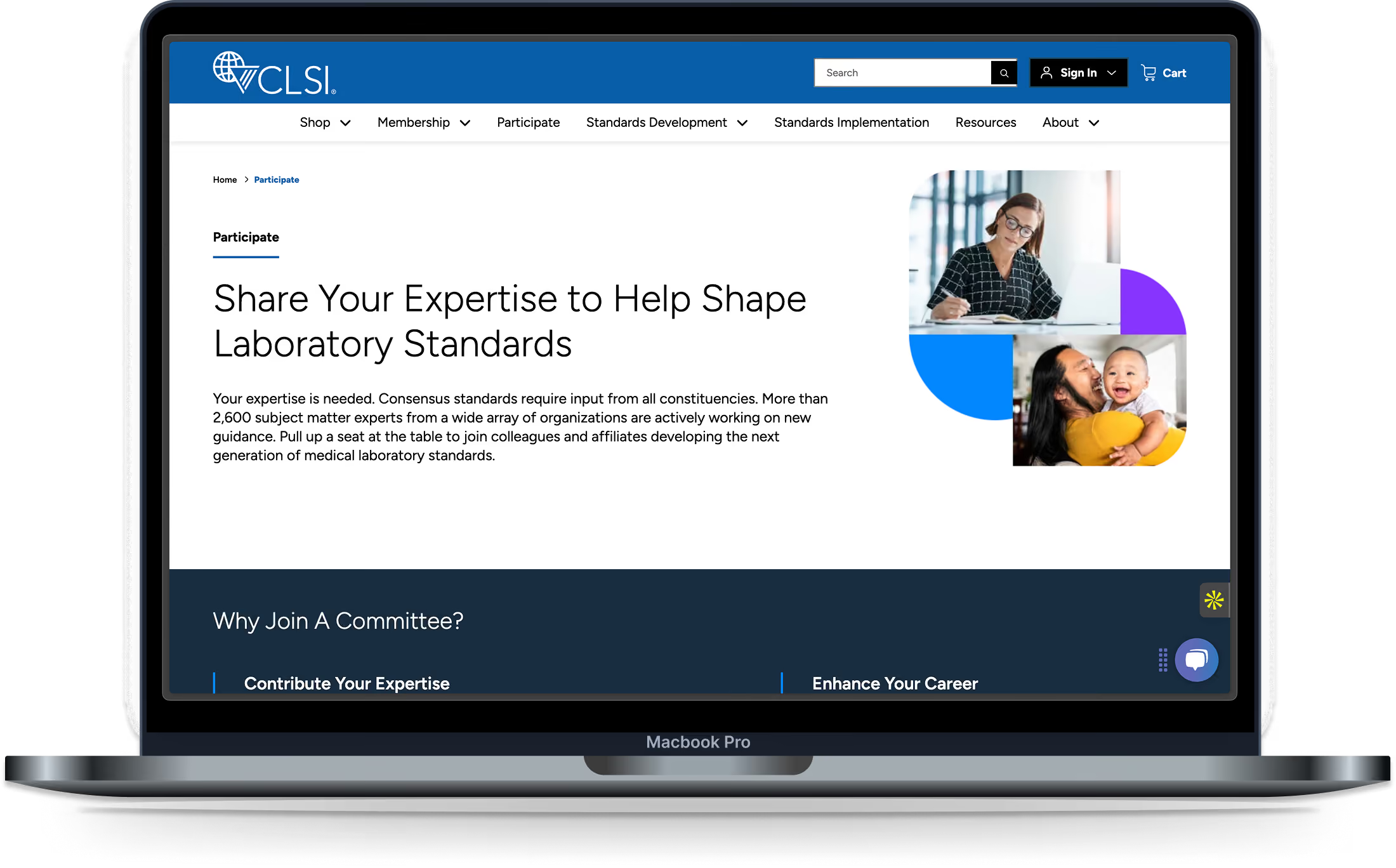
Key Performance Indicators
About CLSI
The Clinical and Laboratory Standards Institute (CLSI) plays a critical role in global laboratory medicine by setting evidence-based standards used in over 100 countries. But by 2023, its digital infrastructure was falling behind the quality of its mission.
Legacy platforms made even minor updates time-consuming. Key user journeys, like purchasing a standard, renewing membership, or volunteering, were buried under complexity. Sales and marketing were siloed, and internal teams were struggling to operate at scale.
CLSI partnered with Agency 39A to rebuild its digital foundation from the ground up, uniting strategy, design, and platform modernization into a single, goal-driven transformation.
Challenges
CLSI’s digital ecosystem was no longer supporting its strategic objectives. It was blocking them.
- Legacy platforms (Umbraco, NetForum, Zendesk, and others) were poorly integrated and expensive to maintain
- User experience was fragmented, with bloated navigation and low-converting journeys
- Sales and marketing workflows operated in silos, with no shared view of the customer or conversion funnel
- Compliance gaps (WCAG, GDPR, CCPA) posed legal and reputational risk
- Search visibility and organic traffic were stagnant, impacting reach and growth
These issues weren’t isolated. They were structural—and solving them would require a coordinated rebuild across content, systems, and strategy.
What the audit revealed
The most consequential finding was not a design problem. CLSI was already reaching an enormous audience through search, and capturing almost none of it.
- 4.17 million non-branded searches a year, converting at a click-through rate of just 1.6%
- Only 65,100 clicks reaching the site from those impressions
- M100, CLSI’s flagship standard, published on a page titled “m100Ed34” and ranked 7th for “m100”, a term with 2.9k monthly searches
- 4,607 pages carrying no title tags, already driving 44% of all search impressions
- 34,420 URLs on temporary redirects and 101,546 canonicalized URLs consuming crawl budget
- Analytics that could not be trusted: tracking missing from the login page, duplicate tags running for three years, and social traffic mis-attributed at source
The demand was already there. The site simply was not built to capture it.
What we did
Our engagement began with an intensive Discovery process: 27 stakeholder interviews across more than 60 hours of conversation, 23 systems audited, and over 100 discrete findings synthesized. This work led to the identification of four pillar goals that would guide every decision moving forward:
- Drive growth and revenue through improved digital experiences
- Increase member engagement and retention
- Elevate brand authority with modern UX and content
- Enable internal scalability with integrated, manageable systems
With these goals in place, we executed a full-scale transformation:
- Rebuilt the Umbraco CMS on .NET Core, improving performance and long-term maintainability
- Integrated NetForum AMS to streamline commerce, data, and user management
- Deployed HubSpot across CRM, marketing automation, and service desk, replacing four disconnected tools
- Redesigned information architecture, reducing 20+ nav items to focused, role-based journeys
- Launched myCLSI, a personalized dashboard for members, volunteers, and learners
- Reimagined ecommerce and content flows, with SEO-optimized templates, upsell paths, and dynamic CTAs
One of the highest-yield changes required no new content at all. CLSI’s product pages averaged under 100 words, far short of what ranking demands. Rather than commission new copy, we surfaced the Abstract, Foreword, and Scope already contained inside each standard onto its product page, lifting pages past 1,000 words and raising the average page SEO score from 2.8 to 7.0 out of 10.
Every feature was designed to tie back to one or more of the strategic goals, measured, intentional, and scalable.
Outcomes
Six months after launch, CLSI’s new digital platform is delivering measurable, sustained impact across user engagement, acquisition, and internal operations. With a clearer value proposition, streamlined UX, and fully integrated systems, the organization is better equipped to serve its global audience, and grow with confidence.
- Membership page views increased by nearly 30%, supporting stronger conversion performance
- Product page views rose 18%, adding more than 68,000 new views
- Subscription page traffic grew 145%, reflecting heightened interest in long-term value
- Embedded CTAs converted at 48%, generating 444 new newsletter signups
- Site search usage jumped 70%, elevating the search results page to the second most viewed on the site
- A newly launched “product notify” feature captured nearly 400 high-intent leads
Search visibility moved just as decisively. Within seven weeks of launch:
- 26% increase in top-three keyword rankings, the positions that capture roughly 54% of all search clicks
- 19% growth in top-ten rankings
- 42% increase in non-branded search impressions
- “Quality laboratory testing” moved from position 79 to 9, “medical laboratory evaluation” from 30 to 6, and “safety in clinical laboratory” from 21 to 5
Just as importantly, internal teams are now operating on a unified platform, with clearer workflows, full visibility into the customer journey, and the tools they need to scale impact without added complexity.
Agency 39A brings the same rigor to life sciences marketing across standards organizations, labs, and research brands.
Let's talk
Meet our team, ask questions, and get the answers you need to move forward and improve your digital strategy.
What our clients say
“Agency 39A’s expertise in design and development - paired with their strong understanding of the healthcare industry - has made them a perfect fit partner for San Ysidro Health. The team is professional, responsive, knowledgeable, and kind. With their help, we’ve revolutionized our digital presence for patients and are already seeing the benefits!”
Brett
/
San Ysidro Health
